
7 Panel Interview Mistakes That Sink Indian Candidates
7 panel interview mistakes that cost Indian candidates the job, with fixes for eye contact, silence, unstructured answers, and panelist research.
7 Panel Interview Mistakes That Sink Indian Candidates
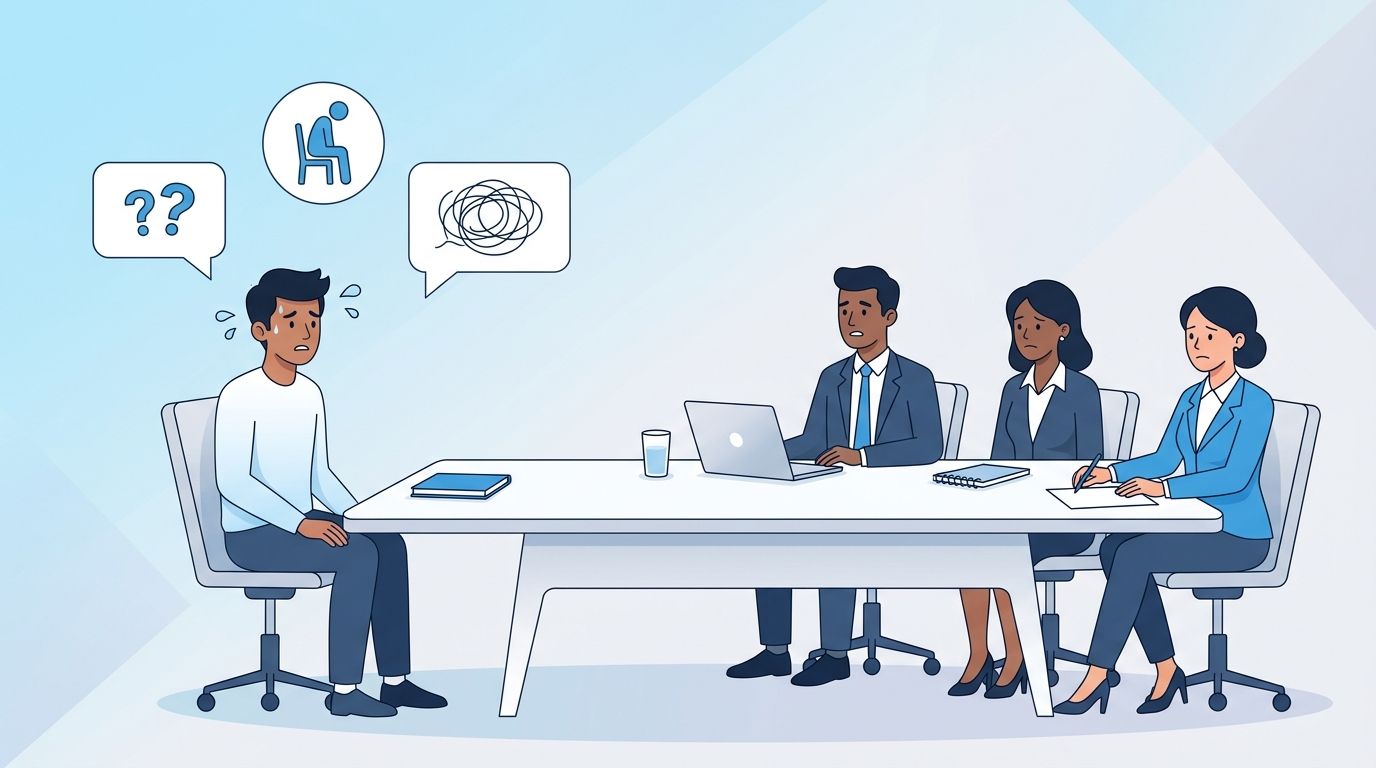
You walk in. Three pairs of eyes — sometimes five — lock onto you. One panelist scribbles notes before you finish your first sentence. Another leans back, arms crossed. This is the panel interview, and if you are a mid-to-senior professional in India, it is increasingly the format you will face at companies like Amazon India, McKinsey, Deloitte, HDFC, and most large MNCs. Panel interviews are standard for senior and specialist hires because they let companies assess multiple competencies in one session and reduce individual bias. But the format amplifies pressure in ways one-on-one interviews do not, and the mistakes that sink candidates in panels are different from the ones that sink them in standard rounds.
1. Anchoring Your Gaze on One Person
The most common panel mistake. You find the friendliest face — usually the most senior panelist — and talk to them the entire interview. The other panelists feel ignored.
Fix: Start your answer looking at the person who asked the question. As you develop the answer, sweep your gaze to include the others. Close by looking back at the original questioner. Every panelist has decision weight — the quiet note-taker may be the one who blocks your hire.
2. Filling Silence With Nervous Talking
Panel interviews have more silence than one-on-one rounds. Panelists write notes, confer quietly, or transition between questions. A 5-10 second pause after your answer is normal. Do not fill it with rambling or backpedaling.
Fix: Finish your answer. Stop. Wait. If 10 seconds pass and no one speaks, "Shall I continue?" is enough.
3. Giving Flat, Unstructured Answers
In a one-on-one interview, you can read the room and adjust mid-answer. In a panel, different people want different things from the same answer. The technical lead wants evidence. The senior leader wants the headline. The HR partner wants culture alignment. A flat, unstructured answer serves none of them.
Fix: Use the 3-layer structure. Layer 1 (10 seconds): The headline. Layer 2 (30-40 seconds): The rationale. Layer 3 (40-60 seconds): The evidence — a specific example with numbers. Example: "The biggest improvement I drove was rebuilding incident response. The process had no clear ownership, so every incident became a blame cycle. I mapped a RACI, introduced blameless postmortems, and our mean time to resolution dropped from 4.2 hours to 1.1 hours in two quarters."
4. Not Researching the Panelists
According to Indeed India's panel interview guide, researching each panel member's role is one of the most effective preparation strategies. Most candidates research the company. Few research the individuals.
Fix: Ask HR who will be on the panel before the interview. Look up each person on LinkedIn. When the technical lead asks about a project, go deep on architecture. When the hiring manager asks the same project, lead with business impact.
5. Mishandling Conflicting Questions
Sometimes panelists ask contradictory questions. One probes deeper on something another accepted. Candidates panic and either apologize or contradict themselves.
Fix: Acknowledge the probe and build on your answer. "That's a useful addition to [Name]'s question. To build on what I said — [add the nuance]." This shows composure and intellectual honesty. Never apologize for a previous answer unless you genuinely made a factual error.
Fix: Prepare 2-3 questions, each for a different panelist. To the hiring manager: "What is the biggest challenge this team needs to solve in 6 months?" To a peer: "What does day-to-day collaboration look like?" To HR: "What are the next steps and timeline?"
7. Treating It Like a One-on-One With More People
A panel interview is a fundamentally different dynamic. SHRM's interviewing guidelines note that structured panels — where each panelist evaluates specific competencies — produce significantly better hiring decisions than unstructured group interviews. Different panelists evaluate you on different axes.
Fix: Map the likely panel composition before the interview: a hiring manager (role fit), an HR/HRBP (culture fit, compensation), a peer (working style), a technical lead (depth), and sometimes a senior leader (strategic alignment). Tailor your answers to address multiple axes simultaneously.
Quick Preparation Checklist
- Get panelist names and roles from HR before the interview
- Look up each panelist on LinkedIn — note their background and focus areas
- Prepare 2 answers in the 3-layer format (headline, rationale, evidence) for your top projects
- Practice maintaining eye contact with 3-4 people simultaneously — try it in a mock interview first
- Prepare 2-3 questions, each targeted to a different panelist's role
- Research the company's recent news, product launches, or challenges
- Review your resume to align your project examples with the role's requirements
- Plan your arrival — panel interviews rarely start late, and being rushed kills composure
For senior roles in India, a Naukri job posting often lists 5-10 required competencies. A panel interview is the company's way of evaluating all of them in one sitting. The candidates who succeed are not the ones with the best answers — they are the ones who understood that each panelist was asking a different question, even when the words sounded the same.
Ready to put this into practice?
Practice mock interviews, build your resume, and get expert feedback — all on PrepFox.
More from PrepFox Blog
How to Crack Aptitude Interview Questions in Placements
How to crack aptitude interview questions in Indian placements: quant, reasoning and verbal sections, an 8-week plan, and test-day strategy.
9 Questions to Ask the Interviewer That Impress HR
Interview questions to ask the interviewer: 9 smart questions that impress Indian HR, what each one signals, and what never to ask in round one.
How to Answer Civil Interview Questions as a Fresher
How to answer civil interview questions as a fresher in India: slump test, foundations, cement tests and salary data for site engineer offers.